De-risk Java application rewrites

Maintain access to existing Java applications while building their replacement

Rewriting a business-critical Java application takes time. During that process, teams still need to support users, maintain access, and keep legacy environments operational. That often means carrying the cost and risk of desktop Java, Citrix, VDI, or ageing deployment models for longer than planned.

CheerpJ allows existing Java applications to run in the browser while a replacement system is developed, helping organisations reduce delivery risk without forcing a big-bang cutover.

Who this solution is for

Designed for organisations that:

  • Are planning or executing a Java application rewrite
  • Need to maintain access to legacy systems during transition
  • Want to remove dependency on desktop Java or VDI before the rewrite is finished
  • Need a lower-risk path from legacy application to replacement platform

Not designed for teams looking to:

  • Use CheerpJ as the final replacement application
  • Rebuild Java applications inside CheerpJ
  • Modernise greenfield applications with a browser-native front end

The problem enterprises face

Rewrites rarely remove legacy risk on day one. In most programmes, the old system must stay operational for longer than expected.

Rewrite timelines slip

Large application rewrites take longer than planned, especially when business logic, integrations, and edge cases are involved.

Legacy environments must stay alive

Teams must keep supporting desktop Java, old browser configurations, or virtual desktop environments while the new system is being built.

Big-bang cutovers are risky

Replacing a business-critical application in one step increases operational risk, user disruption, and rollback complexity.

Users still need reliable access

Business teams cannot pause operations while modernisation programmes run. Access and continuity still need to be maintained.

The challenge is not only building the replacement. It is keeping the existing system usable until the replacement is ready.

Where this works best

CheerpJ fits programmes where legacy Java access needs to continue during a phased migration.

Oracle Forms replacement

Maintain browser access to Oracle Forms environments while replacement programmes are delivered in phases.

Swing and AWT rewrites

Keep existing Java desktop-style applications available without local Java installs.

Multi-year transformation programmes

Support continuity where delivery is split across multiple releases, teams, or workstreams.

This is a transition strategy for legacy Java delivery, not a substitute for the rewrite itself.

The CheerpJ approach

Keep the existing Java application available in the browser while the new system is built in parallel.

Browser execution

The existing Java application runs directly in the browser using a WebAssembly-based runtime.

Browser access

Users access the legacy application through a URL instead of a local Java setup.

Phased migration

Move users and workflows to the replacement system in stages rather than all at once.

Parallel transition

The rewrite can proceed on its own timeline while users continue working in the current system.

No client installs

Remove dependency on Java installs and machine-by-machine desktop configuration.

Lower migration risk

Reduce pressure for a single cutover by maintaining controlled access to the legacy application.

No forced VDI dependency

Reduce or remove reliance on Citrix and virtual desktop infrastructure for legacy Java delivery.

Without vs with CheerpJ during a rewrite

Two ways to support users while a Java replacement is being delivered.

Without CheerpJ

  • Legacy desktop access must stay in place
  • Desktop Java or VDI remains a dependency
  • Operational risk grows if rewrite timelines slip
  • Pressure builds toward a high-risk cutover
  • User access depends on ageing delivery models

With CheerpJ

  • Legacy application access moves to the browser
  • Desktop Java dependencies can be reduced earlier
  • Rewrite teams work on a more realistic timeline
  • Migration can be phased by user group or workflow
  • Continuity is maintained during transformation

CheerpJ reduces delivery pressure by keeping the current application available while the replacement catches up.

What this enables

Maintain browser access

Keep legacy Java applications available without relying on outdated desktop delivery models.

Reduce pressure

Give rewrite teams more realistic timelines without exposing business users to avoidable disruption.

Protect user continuity

Support ongoing business operations while new workflows are delivered and tested.

Phase migration

Move users, modules, or workflows in stages rather than forcing one cutover date.

This is not a replacement for your modernisation strategy. It is a way to execute that strategy with less delivery risk.

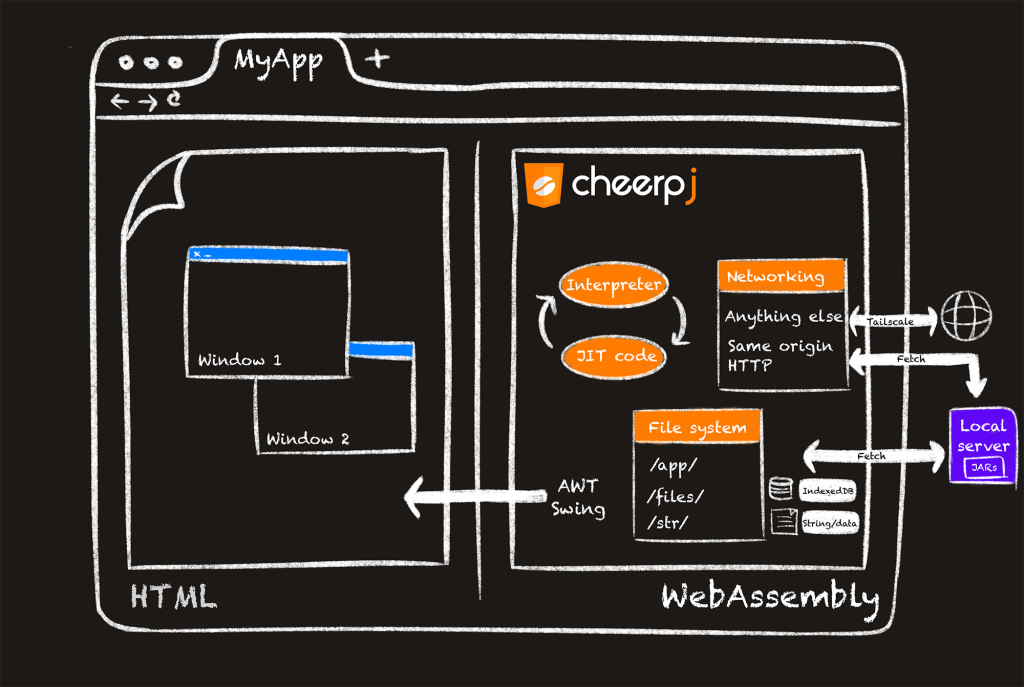
Typical deployment model

Application unchanged

Existing Java application remains available during the rewrite

Runtime in browser

CheerpJ provides the Java runtime inside the browser

Backend unchanged

Existing backend services and databases remain in place

Migration in parallel

Replacement system is built and rolled out in phases

Architecture overview

CheerpJ keeps the legacy Java application available in the browser while the replacement application is delivered in parallel.

Request a demo

See how CheerpJ can help maintain access to legacy Java applications while your replacement system is being built.

Book a demo to review your rewrite programme, delivery model, and application compatibility.

    Leaning Technologies needs the contact information you provide to contact you about our products and services. You may unsubscribe from these communications at any time. For information on how to unsubscribe, as well as our privacy practices and commitment to protecting your privacy, check out our Privacy Policy.